There are requests that arrive without warning and change the trajectory of a company. More than thirty years ago, one such request led us into the world of sacred fabrics: we were asked to create a material for the clergy and we chose to take on a field that was entirely unexplored for us. From that unexpected request, a new path took shape, one capable of uniting tradition, research, and artisanal sensitivity.
A vocation born from listening
Our entry into the sacred textile sector did not come from a strategic plan, but from what best represents our identity: listening to a real need and transforming it into a concrete project. Through study, trials, and development, we began to understand the peculiarities of a field in which every detail carries meaning and precision is not an option but an essential condition.
Prato has historically been a district rooted in carded wool, yet from the very beginning we chose to follow a different path: combed wool, fine yarns, and a focus on the construction of the fabric rather than production volume. This vocation still allows us today to work in the clerical sector with the approach of an artisanal textile workshop, capable of handling complex and unique projects, while remaining true to our identity.
Tradition, craftsmanship, innovation: the foundation of sacred fabrics
The world of sacred fabrics demands meticulous attention to process. Every fabric must use fine natural fibres, ensure liturgical tones that remain stable and repeatable over time, and offer complex designs that remain clearly legible even from a distance. Achieving this balance is no simple task.
In this context, tradition is not something to be preserved statically, but interpreted. Weaving becomes a language through which iconographic elements, such as symbols, geometries, architectural and liturgical motifs, are translated onto fabric. It is a responsibility we approach by combining technical rigor with aesthetic sensitivity, aware that these textiles are not mere materials but an integral part of a sacred rite.

The value of the vestment, beyond the fabric
The most attentive observers can perceive in the colours, symbols, and textures of sacred textiles a narrative made up of stories and values that, in some way, also speak of the person wearing them. A frequently shared anecdote is that a priest choosing the vestment for his first Mass is akin to a woman choosing her wedding dress. This deep emotional bond must be honoured and enhanced by the fabric selected and by the way it is crafted.
For this reason, those who produce such textiles see far more than a material object: they see something that, through aesthetics, expresses the culture and devotion that lie behind the sacred rite. This is what we like to define with the word “responsibility”: the awareness that the fabric is not an ornament but a vehicle of meaning.
The comparison with a wedding dress is no coincidence: like a garment designed for a once-in-a-lifetime moment, a vestment must preserve memory, identity, and symbolism. And to do so, every element must be perfectly calibrated: its drape, luminosity, strength, and the balance between background and motif.
The technical demands of sacred fabrics
The production of sacred fabrics is filled with complexities that often remain invisible to those who see only the finished product. Chasubles, our most distinctive garment, require a fabric width of at least 165 cm, exceeding the standard sizes used in the fashion industry. This allows for large-scale motifs, harmonious drape, and continuity in the design.
The yarns, always natural, are studied to provide structure, opacity, and a finely tuned sheen, especially when the project includes metallic inserts evoking gold or silver. Finishing processes, likewise, are the result of years of research: treatments that increase luminosity without excess, improve the garment’s smoothness, enhance contrast between background and design, and give the fabric a rich yet balanced visual presence. Nothing is left to chance, particularly because production runs are small and of extremely high value: even a minor error could compromise the entire project.
Unlike the fashion world, shaped by unpredictable trends and seasonality, sacred textiles follow the rhythm of the liturgical calendar. This allows for more precise planning but also requires deep knowledge of the chromatic and symbolic codes tied to feasts and celebrations.
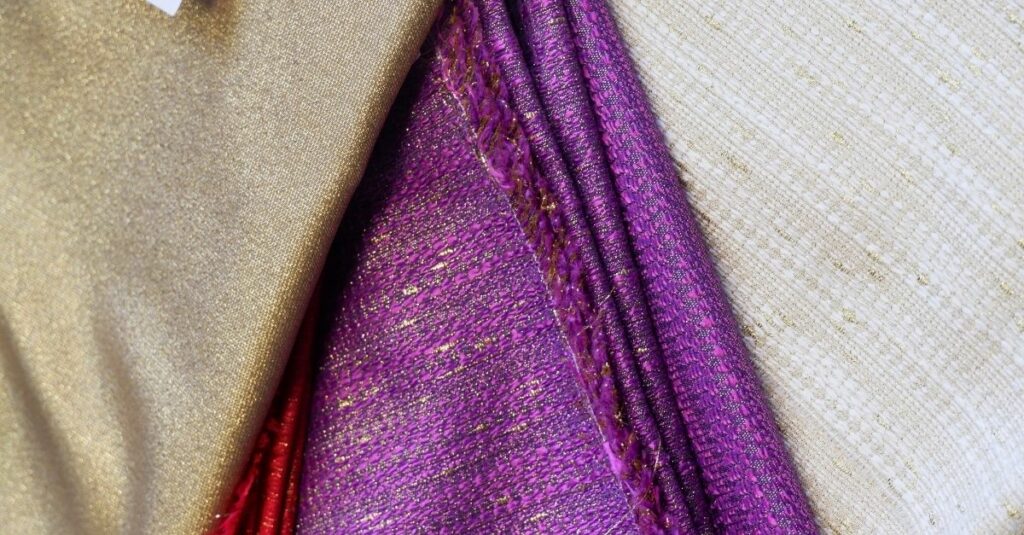
In our work, we come close to the care of an artisanal workshop: we produce classic fabrics that are always available, but we also develop completely bespoke projects. Production runs may span several meters or be as small as 20 centimetres, a rarity in our sector.
Our in-house design allows us to create unique and contemporary motifs without losing our connection to liturgical tradition. Symbolism and innovation coexist, dialogue, and enrich one another.
A story that continues to intertwine
Today, our sacred textiles reach clients worldwide, with Rome as the natural centre of this sector. Some chasubles made with our fabrics have been worn by Benedict XVI and Leo XIV, as well as on occasions of great international significance, such as the wedding of the Prince of Monaco. These are stories we will explore in greater depth over time, as they stand as a source of pride for us and a tangible testament to the value of our work.
Clerical production is not a parallel branch of our core business: it is one of the highest expressions of our way of designing and creating textiles. It represents listening, material culture, research, technical competence, and the ability to transform an idea into something that is much more than a fabric.